


Non Verbal Reasoning :: Cubes and Dice
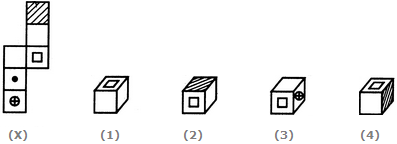
The sheet of paper shown in the figure (X) given on the left hand side, in each problem, is folded to form a box. Choose from amongst the alternatives (1), (2), (3) and (4), the boxes that are similar to the box that will be formed
-
Choose the box that is similar to the box formed from the given sheet of paper (X).
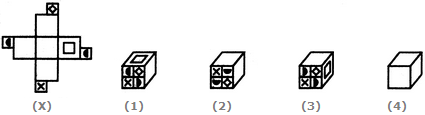
-
Choose the box that is similar to the box formed from the given sheet of paper (X).
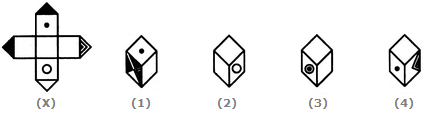
-
Choose the box that is similar to the box formed from the given sheet of paper (X).
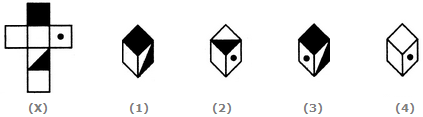
-
Choose the box that is similar to the box formed from the given sheet of paper (X).
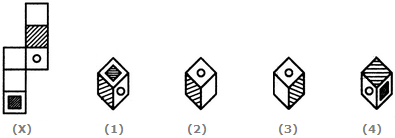
-
Choose the box that is similar to the box formed from the given sheet of paper (X).

-
Choose the box that is similar to the box formed from the given sheet of paper (X).
-
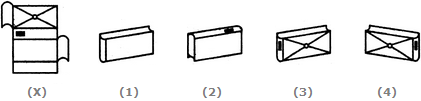
Which of the following finished patterns can be obtained from the piece of cardboard (X) shown below?
-
Choose the box that is similar to the box formed from the given sheet of paper (X).

-
Choose the box that is similar to the box formed from the given sheet of paper (X).
-
When the following figure is folded to form a cube, how many dots lie opposite the face bearing five dots?


 Whatsapp
 Facebook


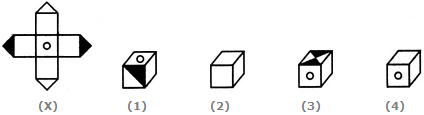
 is one of the faces of the cube and this face lies opposite to a blank face. Also, a face bearing a square lies opposite to another blank face. The remaining two blank faces lie opposite to each other. Clearly, in the cube shown in fig. (1), the face consisting of the four symbols is not the same as that formed (as shown above). Hence, the cube in fig. (1) cannot be formed.
 is one of the faces of the cube and this face lies opposite to a blank face. Also, a face bearing a circle lies opposite to one bearing a dot. Clearly, this cube does not have faces as shown in the cubes in figures (3) and (4). Hence, only the cubes shown in figures (1) and (2) can be formed.
 is one of the faces of the cube and this face lies opposite to the face bearing a circle. Also, one of the blank faces lies opposite to another blank face and yet another blank face lies opposite to the fourth blank face. Thus, out of the four blank faces, no three faces can appear adjacent to each other.
 , the cube in fig. (2) cannot be formed since it shows three blank faces adjacent to each other and the cube in fig. (3) cannot be formed since the face
  cannot appear adjacent to the face bearing the circle. Hence, only the cube in fig. (4) can be formed.